Ngan
Context -about practice
Tea's Times by the Photography Department of Camberwell
I took part in the exhibition in collaboration with the Horniman Museum. The museum's origins in the profits of the tea trade are being reconsidered through a decolonial lens in its new exhibition: 茶, चाय Tea. Students, staff and alumni of UAL, through a project led by Fine Art Photography at Camberwell, have made work in response. The artwork explores individual and specific relationships to tea and photography.
I enjoyed the process of making these works that are responding to a specific context. We all met Navjot Mangat, the curator of the Horniman show, who stresses the importance of collaborating with different community groups in which tea plays an integral part in their cultures. This is also reflected on the curatorial direction. The whole was original conceived to be telling the imperial and colonial history through tea. The participation of co-curating groups change the course to a more diversified approach, and the culture elements are highlighted. This makes me reflects on the role of my work. I appreciate the cultural diversity experienced in it as an exhibition in a heritage museum. But pondering about my own cultural identity, the heart of its relationship with tea is, undoubtedly, the imperial and colonial history.
Eventually I made two work in response. In 8118: Papaver somniferum L. in Cyanotypes (1842-2023) , I made three cyanotype prints with images of opium poppies. They were brought from India by the East India Company as specimens in the 19th century. Two of the prints were toned with “Oxford Breakfast Tea” brought from Hong Kong. The “British” tea is blended with a modified recipe to adapt to the taste of Hongkongers. The work encapsulates the history of tea trade and its unthinkable consequences: from tea to opium and the fate of Hong Kong (and its people). Cyanotypes, being one of the oldest photographic printing processes, was introduced by astronomer and chemist John Herschel in 1842, the same year when Hong Kong Island became a British colony after the First Opium War.


8118: Papaver somniferum L. in Cyanotypes (1842-2023) (2023)
Cyanotype prints, 35cm x 45cm
(Exhibition view)
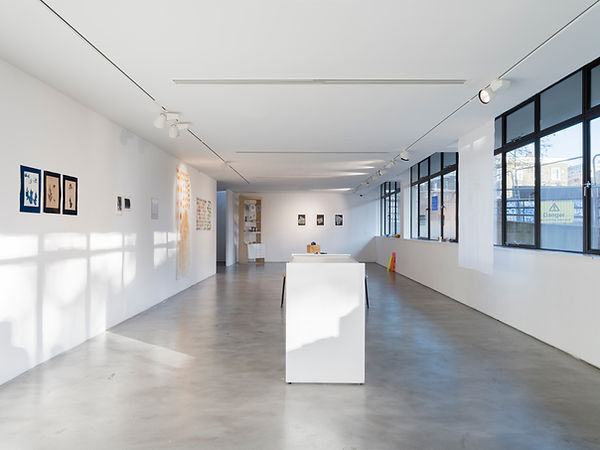


Cave Painting (in the Case of Tea) focuses more on personal history. The work is made from tea stain painting on the wall of a mug that illustrates one’s history of tea drinking. Viewers are invited to enter a cave of sedimentation of taste, conversations and moments.

Cave Painting (in the Case of Tea) (2023)
Mixed media, Size variable
(Exhibition view)


The works are in different mediums and of different ways of display. During the group crit, I was asked about the decision to put some components of the work Cave Painting (In The Case of Tea) in the display cabinet. The question reminds me of the importance of these curatorial decisions, and that they should be made to get the audience to the heart of the work. I deliberately display the tea mug as an artifact, as it embodies one’s personal history of drinking tea. The artwork, which is a 360-degree image of the tea mug’s interior, is presented as a scroll, which can also serve as another artifact. The display creates a contrast to the surrounding artwork and arouses the viewers’ curiosity, but at the same time reflects the work’s nature.
More on Horniman’s 茶, चाय Tea exhibition:
https://www.horniman.ac.uk/event/cha-chai-tea/
The exhibition was also featured on UAL’s newsletter: