Ngan
Critical Reflection - The Beginning
My enquiry about internet images began with graffiti in Hong Kong.

Photo from the New York Times
Tsang Tsou-choi was a graffiti artist widely known to Hongkongers as the “King of Kowloon”. Mr Tsang’s work largely vanished from the streetscape since his death in 2007. In March 2022, parts of Tsang's graffiti had resurfaced after the paint that covered his work had peeled off a wall under a railway bridge at Boundary Street.
When I visited the location, I noticed that the other side of the bridge was painted with the shape of several rectangles. This is a common sight of the city as protest graffiti painted during the political movement in 2019 were all covered. I was intrigued by the contrast of the two sides. I resorted to Google Street View (GSV) for the transition of streetscape of this spot, where old words revealed and newly written words were covered. By slowing down the transition effect on the GSV interface, the screen captures have a soft tone and a double-exposure effect that is not usually noticeable to the human eye in normal viewing.


Screenshots from GSV
I travelled around the city on GSV and captured screenshots that display the transition of images taken at various streets between 2019 and 2020, when the protest graffiti was being covered. While the transition on GSV and that of the city itself can occur in a blink of an eye, viewers can experience and grasp traces in between the process through this work. The "in-betweenness" conveyed in the images reflects the status of Hongkongers who carry memories of the 2019 movement.


Hong Kong Type (2023); Screenshots from GSV
My work probes into the visual paradigm of Surveillance Studies. Google Map Services has changed how we observe, conceive and navigate the physical space. Being capable to achieve so, it has developed into a apparatus of what David Lyon describes as “Big Data Surveillance” (Lyon, 2014), and we are now living in a state of what Mark Andrejevic calls “digital enclosure” (Andrejevic, 2007). This state of being digitally enclosed is “ of equipping oneself with the appropriate technology: devices that allow users to communicate with the network, to gather information from it, and to supply information to it. Entering the enclosure is about embracing interactive technology”.
In their analyses on the relationship between GSV and performances, Chris Ingraham and Allison Rowland further examines GSV’s role in the state of digital enclosure (Ingraham and Rowland, 2016). They pointed out that as GSV cars patrol a street, one “need not be equipped with networked technology…to become digitally enclosed. In other words, even if you withdraw from the digital altogether, the digital now comes to you”. As physical spaces are captured and being digitalised as images, GSV cars, as “automated digital processes”, have made the digital enclosure “universal, flexing the already flexible boundary of the virtual and physical”, and that no one can avoid by going off-grid. These interactions are also connected to the idea of platform urbanism, of which platforms operate in a way that changes how people experience the physical space, and encourages their users to generate values on them, without the platform themselves doing it.
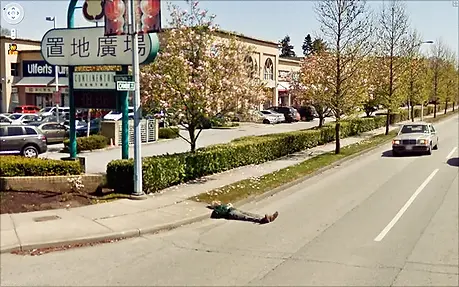
Jon Rafman's Nine Eyes of Google Street View
(2008-ongoing)

Michael Wolf's A Series of Unfortunate Events
(2009-2010)
Artists have been responding to GSV’s omnipresence, and in a way they are generating values on them. In 2008, internet artist Jon Rafman began to collect screenshots of images from Google Street View which develops into the project Nine Eyes of Google Street View. Photographer Michael Wolf also curates his own edition of A Series of Unfortunate Events. Both artists make use of GSV’s “materiality”: that GSV cameras are automated and the photographer is absent. The presentation of GSV images is, as Ingraham and Rowland describe, “an indifferent biopolitical mechanism whose operationalized logic reduces everything to ones and zeroes”.
My work is also situated in this paradox of GSV’s role as an actor of the surveillance apparatus and an image maker without a photographer. Facing these automatically captured and presented images, the artist’s role is to empower them by actively curating them. As such, the artist enables GSV, as a navigation tool, to at the same time serves as an archive and a medium of expression.
I also attempt to explore dimensions of a photograph through my work. Photography is considered to be a medium that compresses the four-dimensional tangible world into the two-dimensional, or a plate surface. Through reading the photographic work the viewers reconstruct the four-dimensions in their mind. This reconstruction process is amplified by the way these “historical” images are presented on GSV, with the timeline interface that enables “travelling back in time” and its transition effect.