Ngan
Critical Reflection - On Surveillance
It is universally acknowledged that (moving) images are everywhere, surveillance is ever-present and everyone is longing for spectacles. We are constantly under watch, posing for the camera and hunting for things to watch. There is a paradox that while we generally resist to (involuntary) surveillance, many of us have the desire to expose our (curated) private lives to an audience, chiefly on social media platforms, and this becomes a form of voluntary surveillance. The two realms, with one that seeks our attention and the other be worth of our attention, have already contributed to footage with a duration that exceeds one’s lifetime.
Surveillance films encapsulate all of the above. They are everywhere, as David Lyon suggests that “to participate in modern society is to be under electronic surveillance” (Lyon, 1994). It is reported that the UK has more surveillance cameras per person than any country except China. But indeed surveillance is of a global prevalence, and the footage is consumed as spectacles. Compilations of CCTV clips have garnered millions of views on YouTube.

Screenshots from Youtube. CCTV footage is readily consumed online as spectacles.
Looking at images to this magnitude, people are seeing but they are not actually seeing. Regarding this phenomenon, one can draw insights from Björk, the Icelandic singer-songwriter, who has once shared her view on TV, in a TV interview in 1988. Explaining to the viewers what a television was, she quoted an Icelandic poet who claimed that on a TV there were “millions and millions of little screens that send some sort of electric light” to the viewers, and that “our head is very busy all the time to calculate and put it all together into one picture. And then because we are so busy doing that, we don’t watch very carefully what the programme we are watching is really about. So we become hypnotized.” What she said 30 years ago is a metaphor of the omnipresence of (surveillance) images in our times.
Bjork talked about TV in a TV interview in 1988, which has become an unintentional ASMR experience in modern times
My initial idea is to address this omnipresence and to explore the paradox of involuntary and voluntary surveillance by putting the two realms in juxtaposition. All of these surveillance films would form a spectacle and evoke a desire of seeing/voyeurism in the beholder. The concept of surveillance is to be presented by the prevalence of publicly accessible surveillance camera sources. I also planned put together archival footage explore the role of surveillance in history. For voluntary surveillance, live-streaming footage on platforms such as YouTube and TikTok would be sourced. I also research on previous artists’ work on surveillance.
Work by other artists that features surveillance footage in juxtaposition:
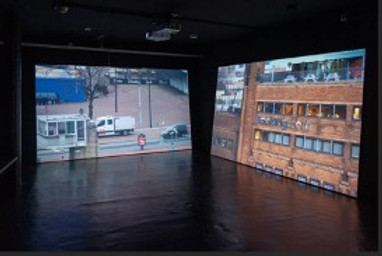
In Cameras Res by Studio CAMP (2019)
3-channel HD CCTV video
20:40
CAMP, Mumbai-based studio – The art group explores video as a medium and an infrastructural condition of life through engaging livestream feeds, everyday CCTV surveillance footage and databases. The group presents this work as “live cinema”.

24 Cinematic Points of View of a Factory Gate in China by Ho Rui An (2023)
4K video, 24′ 45″
Ho Rui An, Singaporean artist – Ho put together surveillance camera footage and archive films in his recent work 24 Cinematic Points of View of a Factory Gate in China.
I then made a test clip with surveillance footage sourced online:
Work that features individual frames of surveillance footage in juxtaposition:

Jamie Wagg produced a large print of a frame of the surveillance footage that showed a child being kidnapped. Commenting on the work, John Walker pointed out its essence lies in its indexical sign, because "in itself the mall picture was mundane, innocuous. Its power to fascinate was surely due to our knowledge of what happened afterwards" (Walker, 1999).
Archival footage: the Zapruder film
